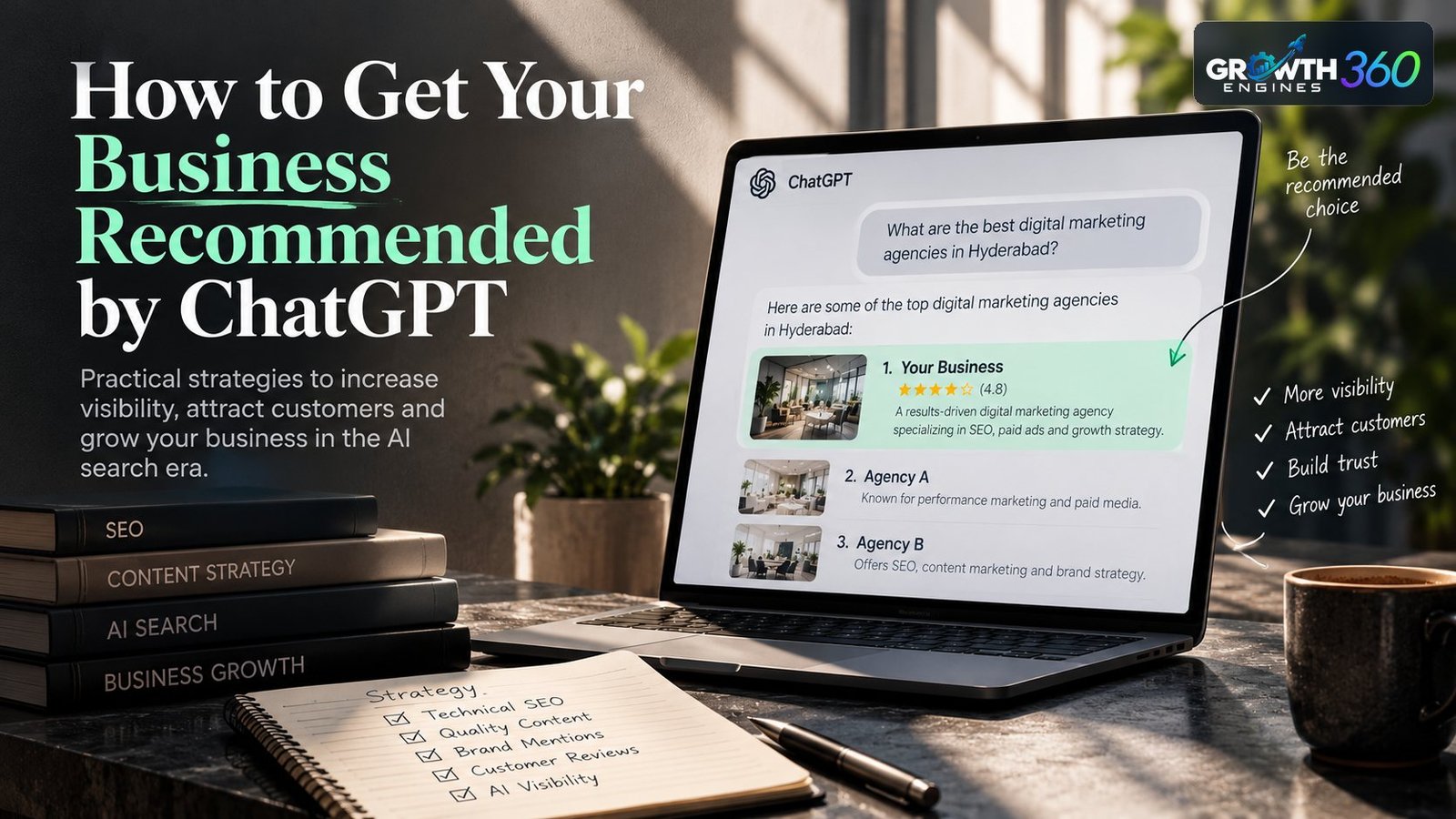
There is a real fear that AI search has made websites pointless and that traditional SEO no longer works. A user can directly post a query on Google and Google’s native AI can give a perfect answer to match the user’s query. The user no longer needs to scroll down and search individual websites to find their answer.
AI answers not only save time but also give users a much better experience online, which is exactly what Google, Meta and the other big tech companies want. A better user experience makes the person use their product more often. People also tend to trust AI answers, which can lead straight to a sale. So if your business gets recommended by ChatGPT, Gemini or any other AI assistant, you can see a real lift in sales, traffic and brand awareness.
The ecosystem has changed. Earlier we used to build websites to attract people. But, now we have to build them to attract AI. At Growth Engines 360, we build for both, and this guide shows you how.
The short answer: To get your business recommended by ChatGPT, make it easy for AI to understand, trust and find you. Answer your customers’ real questions on your website, publish original data, keep your business details consistent everywhere, earn genuine mentions and reviews, and make sure AI crawlers such as OAI-SearchBot can access your pages. Nothing can guarantee a recommendation, but these steps make your business a clear, credible option.
Key takeaways
- Search intent is one of the most important foundations of AI SEO.
- Keep your business information consistent everywhere, and earn genuine third-party mentions and reviews.
- Build an AI-friendly website: let AI crawlers in, add structured data (JSON-LD) and write clear titles and meta descriptions.
- Publish original data and honest test results that competitors can’t copy.
- Measure AI mentions and citations instead of guessing.
Free PDF
Get this guide as a PDF
All 16 steps in one 20-page PDF. Save it, print it or share it with your team.
Enter your email and the download starts straight away. We’ll also send you our newsletter: one short email when we publish a new guide or tool test. Unsubscribe any time. Privacy policy
What Is AI SEO, and Why Does It Matter?
Traditional SEO focuses on helping websites appear in search engine results pages (SERPs). AI SEO expands that goal by helping businesses become visible in AI-generated answers and recommendations.
You may also encounter two related terms:
- Generative Engine Optimization (GEO): Optimizing content and brand information to improve visibility in generative AI responses.
- Answer Engine Optimization (AEO): Structuring information so answer engines can easily identify and present relevant answers to users.
These approaches overlap with traditional SEO. Google confirms that its AI search features continue to rely on established SEO fundamentals, including crawlability, indexing, helpful content, and accurate structured data. Microsoft also explains that conventional SEO practices support eligibility for AI-generated answers and citations.
The objective is no longer simply to rank for a keyword. It is to make your business a relevant, verifiable option when a potential customer asks an AI for advice.
Are Websites Dead Because of AI Search?
Not necessarily. But the way people discover and visit websites is changing.
Consider a customer searching for a digital marketing agency. Traditionally, they might search Google, compare several websites, read reviews, and contact a few agencies.
With AI search, they might ask:
“Recommend a digital marketing agency for a small business that wants more qualified leads without wasting its advertising budget.”
An AI assistant may summarize the available options, compare their services, and provide links to selected businesses or sources.
This creates three opportunities for businesses:
- AI visibility: Your brand appears in an AI-generated answer.
- AI citations: Your website is referenced as a source supporting the answer.
- AI-assisted conversions: A customer discovers your business through an AI recommendation and eventually contacts or purchases from you.
These outcomes are different. A brand mention does not necessarily generate a website visit, and a citation does not guarantee a sale. However, AI visibility can introduce your business to customers who might otherwise never discover it.
The practical strategy is to build visibility across both traditional search engines and AI-powered discovery platforms rather than abandoning SEO.
How Does ChatGPT Decide Which Businesses to Recommend?
There is no publicly documented formula that guarantees a business will be recommended by ChatGPT.
When web search is used, the system can retrieve relevant pages and use them to support an answer. Other recommendations may depend on information available through different sources, the context of the conversation, location, product availability, and the user’s specific requirements.
For example, someone asking for the cheapest email marketing software needs a different recommendation from someone asking for enterprise automation with advanced integrations.
Your business has a better opportunity to be considered when its publicly available information clearly establishes:
- What the business sells or provides.
- Which customers it serves.
- Which problems it solves.
- What differentiates it from competitors.
- Its prices, service areas, availability, and relevant features.
- Evidence supporting its claims and reputation.
The following strategies focus on improving those signals without relying on unverified AI SEO tricks.
1. Match Content to the Actual Intent Behind Customer Queries
Search intent is one of the most important foundations of AI SEO.
AI search systems must identify information that is relevant to the user’s question. Simply repeating the same keyword throughout a page does not establish that the page provides the right answer.
Suppose you sell project management software.
A page targeting “project management software” may attract broad traffic. However, customers may ask much more specific questions:
- What is the best project management software for small teams?
- Which project management tools offer free plans?
- What is the best alternative to Asana?
- Which project management software integrates with Slack?
- What is the easiest project management tool for a non-technical team?
Each question represents a different need.
Create content that directly addresses these needs rather than publishing multiple pages that repeat the same generic product description.
How to implement this
- Identify your ideal customers and the problems they need to solve.
- Collect questions from Google Search Console, keyword research tools, customer conversations, forums, and competitor content.
- Group related queries by intent, such as comparisons, pricing, alternatives, troubleshooting, and buying advice.
- Create a dedicated page or a clearly defined section for each meaningful topic.
- Explain how your offering addresses that need, including its limitations and suitability.
For instance, a page about affordable email marketing software should discuss pricing, subscriber limits, automation features, integrations, and who each tool is best suited for.
This gives search engines and AI systems concrete information to evaluate against a user’s requirements.
2. Create Comparison Articles and Listicles
Comparison pages and listicles can be valuable for AI search because they organize several options around a specific decision.
Examples include:
- Best CRM Software for Small Businesses
- Top 10 AI Marketing Tools for Agencies
- Best Email Marketing Platforms Under ₹2,000 Per Month
- HubSpot vs Salesforce: Features, Pricing and Use Cases
- Best Alternatives to Semrush for Small Businesses
- Best Digital Marketing Agencies for B2B Lead Generation
These formats help readers understand their choices and give AI systems clearly organized information to retrieve.
However, simply publishing a list of ten products is unlikely to provide lasting value if the same information is available everywhere else.
How to create a useful AI-friendly listicle
For each product or business, include:
- Name and official website.
- Primary purpose and target audience.
- Current pricing or a clearly dated pricing reference.
- Key features and limitations.
- Integrations and compatibility.
- Availability and service area, where relevant.
- Independent testing results or verifiable evidence.
- Advantages, disadvantages, and the situations in which the option is appropriate.
When comparing products, explain your evaluation criteria and how you tested each option. Here’s how we test marketing tools, as an example.
For example, a marketing automation comparison could assess setup time, integration reliability, workflow flexibility, monthly cost, and the number of manual steps eliminated.
Important: Never claim to have tested a product if you have not. Distinguish hands-on testing from desk research, and disclose affiliate relationships where applicable.
For local businesses, recommendations can also depend on factors such as availability, price, quality, proximity, and whether the business is the manufacturer or primary seller. These details should be accurate and easy to verify.
3. Answer the Customer’s Question Immediately
AI-friendly content should not force readers to navigate through several paragraphs before reaching the answer.
A useful structure is:
Question → Direct answer → Explanation → Evidence → Practical next steps
For example:
What is the best CRM software for a small business?
The best CRM for a small business depends on its budget, sales process, team size, and integration requirements. A simple contact-management tool may be sufficient for a solo business, while a growing sales team may need automation, reporting, and pipeline management.
The right choice should be evaluated using current pricing, ease of use, integrations, support, and the complexity of your sales workflow.
The answer comes first, followed by context that helps the reader make a decision.
Why this structure works
- Readers can find the answer quickly.
- Important information is less likely to be buried in filler.
- Headings make the page easier to navigate.
- Clear statements are easier to interpret and verify.
- Supporting evidence gives the answer additional credibility.
Use descriptive headings, concise paragraphs, meaningful bullet points, and comparison tables when they genuinely improve comprehension.
Do not turn every paragraph into a one-sentence block just to satisfy a supposed AI algorithm. Clear organization matters more than an arbitrary paragraph length.
4. Publish Original Data, Research and Verified Numbers
One of the strongest ways to differentiate your content is to provide information that competitors cannot simply copy from one another.
Generic articles often repeat the same widely available advice. Original research, detailed product tests, and transparent measurements give readers a reason to consult your website.
Examples include:
- Testing ten AI writing tools on the same five tasks.
- Measuring how long different CRM platforms take to configure.
- Comparing the cost of generating 100 qualified leads across advertising platforms.
- Publishing a survey of 200 small business owners.
- Measuring website speed before and after specific optimizations.
- Comparing email deliverability across tools using a documented methodology.
Suppose you test five AI meeting assistants. Record the setup time, transcription accuracy on your test sample, export options, integration performance, and price.
Your article could then explain which tool performed best for each use case.
How to make your data credible
- Explain the methodology.
- State the sample size and testing conditions.
- Include dates and relevant product versions.
- Separate measured results from subjective opinions.
- Publish screenshots, tables, or supporting evidence where appropriate.
- Disclose limitations and potential conflicts of interest.
Numbers can make a recommendation more useful, but unsupported statistics can undermine trust. Never invent performance percentages, customer counts, savings figures, or test results to make content appear authoritative.
5. Keep Important Information Fresh and Accurate
Fresh information matters when a customer’s decision depends on changing facts.
Software pricing, product features, integrations, company locations, service availability, and business contact details can change frequently.
An outdated page may recommend a discontinued product, quote an old subscription price, or describe a feature that no longer exists.
Build a content freshness process
Review important pages on a schedule appropriate to the information they contain.
| Content type | What to review |
|---|---|
| Software comparisons | Pricing, features, integrations and plan limits |
| Product reviews | Product versions, test results and availability |
| Local business pages | Address, opening hours, services and contact details |
| Industry research | Statistics, source dates and methodology |
| Service pages | Offerings, pricing, locations and case studies |
Update pages when there is a meaningful change. Include a visible last-updated date when it helps readers understand the freshness of the information.
Do not change the publication date merely to make an unchanged article appear new.
6. Build Brand Mentions Across Trusted Third-Party Websites
Your website is not the only place where potential customers learn about your business.
A business may also be discussed in industry publications, independent reviews, comparison websites, professional communities, directories, and customer testimonials.
These sources can help establish that a business exists, what it does, and how other people describe their experience with it.
For example, a cybersecurity company might be mentioned in an industry publication, reviewed by a technology expert, listed in a relevant professional directory, and discussed by customers in a technical community.
This creates a broader, more consistent picture of the brand.
Where to build legitimate brand visibility
- Relevant industry publications.
- Independent product review websites.
- Professional associations and directories.
- Podcasts and expert interviews.
- Customer case studies published by partners.
- Genuine community discussions.
- Reputable comparison platforms.
- Relevant local and business directories.
Prioritize sources that your target customers actually consult.
Do not buy large volumes of low-quality links or publish fake reviews to manufacture popularity. A mention is not automatically valuable simply because it appears on another website.
The goal is to build a verifiable reputation, not manufacture artificial authority.
7. Make Your Website Accessible to AI Search Crawlers
Even excellent content can be difficult to discover if technical settings prevent search systems from accessing it.
OpenAI documents a crawler called OAI-SearchBot, which is used to surface websites in ChatGPT search results. Its search crawler is separate from GPTBot, which relates to crawling for model training.
If you want your website to be eligible for ChatGPT search visibility, check that your configuration does not unintentionally block OAI-SearchBot.
Technical SEO checklist
- Check your
robots.txtfile. - Verify that important pages are accessible without logging in.
- Check for accidental
noindexdirectives. - Make sure your canonical URLs are correct.
- Maintain a valid XML sitemap.
- Use crawlable internal links.
- Check that important content is available as readable text.
- Verify that your CDN, firewall, or bot-protection system does not unintentionally block relevant crawlers.
- Monitor server errors and indexing issues.
OpenAI explains what each of its crawlers does in its official crawler documentation.
One important distinction: allowing a crawler does not guarantee that your business will be recommended. It removes a potential technical barrier to discovery.
You can also control whether you permit particular crawlers for different purposes. Review the official documentation before changing your settings.
8. Use Structured Data and Clear Business Information
Structured data helps search engines interpret information about your business, products, services, and content.
For example, Schema.org markup can describe an organization, a local business, a product, or a published article in a machine-readable format.
Relevant types may include:
OrganizationLocalBusinessand appropriate subtypesProductServiceArticleBreadcrumbList
Choose markup based on the actual content of the page.
A local plumbing company might use appropriate LocalBusiness markup to identify its business name, address, telephone number, opening hours, and official website.
A software review page might use suitable article markup and clearly display the product information, test methodology, and reviewer details.
What about meta descriptions, image alt text and JSON-LD?
These are useful parts of a well-maintained website, but they serve different purposes.
- Title tags: Describe the page’s main topic and help users understand its relevance.
- Meta descriptions: Summarize the page and can help communicate its value in search results.
- JSON-LD: Provides structured information about entities and content.
- Image alt text: Describes meaningful images for accessibility and helps explain their content.
- Descriptive headings: Establish the page’s information hierarchy.
- Internal links: Help people and crawlers discover related pages.
Google explicitly states that no special schema markup is required to appear in AI Overviews or AI Mode. Structured data should accurately reflect visible content, rather than being treated as a shortcut to AI recommendations.
Similarly, an llms.txt file is not a confirmed requirement for Google AI search visibility. Prioritize crawlability, useful content, and accurate information before experimenting with optional technical additions.
9. Maintain Consistent Brand Information Across the Web
AI systems need to distinguish one business from another and interpret what each business does.
If your website describes your company as a B2B marketing agency, your LinkedIn profile calls it a software company, and your directory listings describe it as a general advertising firm, your positioning becomes less clear.
This does not mean every profile must use identical wording. It means the underlying facts should be consistent.
Create a single source of truth for your business
Maintain an approved record of:
- Official business name.
- Website and contact information.
- Core services and products.
- Target audience.
- Service locations.
- Pricing or pricing model.
- Important differentiators.
- Certifications and qualifications.
- Verified results and case studies.
Use this information when updating your website, Google Business Profile, LinkedIn company page, directories, and relevant third-party profiles.
Consistent business details also reduce the risk of customers encountering conflicting information.
10. Optimize Your Google Business Profile and Customer Reviews
For local businesses, local SEO remains an important part of AI search visibility.
A customer asking for a dentist in Hyderabad, a restaurant near their hotel, or a digital marketing agency in their city needs relevant local information.
Maintain an accurate Google Business Profile, including:
- Business name and primary category.
- Address or service area.
- Opening hours.
- Telephone number and website.
- Services and products.
- Current photographs.
- Relevant business attributes.
- Responses to customer reviews.
Encourage genuine customers to leave honest reviews and respond professionally to their feedback.
Reviews can help prospective customers evaluate service quality and suitability. However, there is no guarantee that a specific rating or review count will cause ChatGPT to recommend a business.
Avoid fake reviews, incentivized positive reviews that violate platform policies, and misleading claims about your reputation.
For local businesses, make sure your official website, Google Business Profile, and other important listings provide compatible information about your location and services.
11. Participate in Online Communities and Industry Discussions
Online communities can be valuable places to demonstrate expertise, answer questions, and build genuine relationships with potential customers.
Depending on your industry, these communities might include Reddit, specialist forums, LinkedIn groups, professional communities, and relevant discussion platforms.
For example, a marketing agency could answer questions about lead generation, explain why advertising campaigns fail, or share a transparent case study showing how it improved campaign performance.
A software company could help users troubleshoot integrations or explain the practical differences between competing tools.
How to approach community participation
- Identify communities used by your target customers.
- Answer relevant questions with specific, useful information.
- Share evidence or examples when appropriate.
- Disclose your affiliation when discussing your own products or services.
- Respect each community’s rules.
- Avoid spam, fake accounts, and coordinated self-promotion.
Do not assume that a Reddit mention automatically improves AI rankings. The value is in building genuine visibility, helping potential customers, and creating useful information that people may discover through search.
12. Create Content That Explains Exactly Who Your Business Helps
A business website should make its value proposition unmistakable.
Compare these two descriptions.
Generic description:
“We provide innovative, high-quality solutions to help businesses grow.”
Specific description:
“We help B2B software companies generate qualified sales leads through paid search, conversion-focused landing pages, and automated lead nurturing.”
The second description identifies the audience, service, and intended outcome.
Use this clarity throughout your website, including:
- Homepage headline and description.
- Individual service pages.
- Product pages.
- Case studies.
- About page.
- Frequently asked questions.
- Comparison and alternative pages.
Each major service should have a dedicated page that explains the problem it solves, its process, its ideal customer, expected deliverables, relevant evidence, and important limitations.
Avoid making every service sound identical. Specific information helps customers evaluate your suitability and makes your business easier to distinguish from competitors.
13. Build a Website That Demonstrates Experience and Trust
Trust is not created by adding the word “expert” to your homepage. It is built through evidence.
Useful trust signals include:
- Detailed case studies.
- Original research.
- Transparent product testing.
- Named authors and relevant qualifications.
- Clear company information.
- Customer testimonials with appropriate permission.
- Verifiable certifications.
- References to authoritative sources.
- Clear pricing and terms.
- Contact information and support policies.
For example, instead of writing “We help clients improve their conversion rates,” explain the project, the changes made, the measurement period, the starting baseline, and the verified outcome.
If the result cannot be independently verified, present it as a client-reported result rather than an established fact.
AI search systems may draw information from different sources, so make important claims easy to verify both on your own website and through legitimate external evidence.
14. Make Your Website Useful Beyond the AI Answer
An AI assistant may answer a question without sending the user to your website.
That does not make the website unnecessary.
Your website remains the destination where customers can explore detailed comparisons, inspect evidence, view demonstrations, calculate costs, request a quote, book a consultation, or purchase a product.
Build pages that provide value beyond a short AI-generated summary.
Examples include:
- Interactive product comparisons.
- Cost calculators.
- Free templates and downloadable resources.
- Product demos.
- Detailed case studies.
- Original research reports.
- Quizzes that help users select a product.
- Clear quote and consultation forms.
For an affiliate website, a useful comparison tool or documented hands-on test can offer substantially more value than another generic article listing products and affiliate links.
This is particularly important because AI-generated answers may reduce the need for users to visit pages that merely repeat basic facts.
The stronger strategy is to make your website the place where people go to verify a decision, explore details, and take action.
15. Measure AI Search Visibility Instead of Guessing
AI search optimization should be treated as an ongoing measurement process, not a collection of tricks.
Track whether your brand appears in relevant answers, whether your pages are cited, and whether that visibility leads to qualified traffic or conversions.
What to measure
| Metric | What it tells you |
|---|---|
| AI brand mentions | Whether your business appears in tested AI responses |
| Citation frequency | How often your website is referenced as a source |
| Share of recommendations | How often your brand appears compared with competitors in a defined test set |
| AI referral traffic | Visits attributed to AI platforms where analytics can identify them |
| Engagement | Whether visitors explore useful pages or leave immediately |
| Qualified leads | Whether AI-referred visitors become relevant prospects |
| Conversion rate | Whether those visitors purchase, book, or submit an inquiry |
Tools worth using
Google Search Console: Monitor indexing, search queries, clicks, impressions, and search performance. Review any AI-specific reporting available in your account.
Google Analytics 4: Measure referral traffic, engagement, and conversions from identifiable sources.
Bing Webmaster Tools: Use its AI Performance report, where available, to inspect citations across supported Microsoft AI experiences, including Copilot.
Manual AI visibility testing: Test a consistent set of relevant questions in ChatGPT, Gemini, and other platforms. Record brand mentions, citations, competitor recommendations, and the answer context.
Remember that an AI citation is not the same as a click. Likewise, an AI referral does not prove that the recommendation alone caused a conversion.
Build a repeatable testing process
Create a fixed set of customer questions, such as:
- Best digital marketing agencies for B2B lead generation.
- Best CRM for small businesses under a specific budget.
- Alternatives to a particular software product.
- Best email marketing tools for ecommerce.
- Which agency specializes in a particular industry?
Run the tests periodically, record the results, and investigate patterns.
If competitors consistently appear but your business does not, examine the differences in their service descriptions, relevant content, independent mentions, evidence, and technical accessibility.
Change one or two factors at a time where practical, then measure the results over a reasonable period.
This approach will not reveal an AI platform’s internal ranking formula, but it can help you make better-informed decisions.
16. Turn AI SEO Into a Continuous Improvement Loop
The most effective long-term strategy is to connect content creation, customer feedback, testing, and measurement.
A simple process looks like this:
Research customer questions → Publish useful content → Build credible external visibility → Check technical accessibility → Test AI recommendations → Measure leads and citations → Improve what works.
For example, if your software comparison page begins receiving more relevant AI citations, inspect its structure, evidence, freshness, and query coverage. Use those observations to guide your next experiment.
Do not automatically assume that one content change caused an increase in visibility. User demand, competing pages, and AI platform changes can all affect results.
Over time, a documented feedback loop helps you distinguish repeatable improvements from temporary fluctuations.
Final Thoughts: Build a Business That AI Can Understand and Trust
Getting recommended by ChatGPT is not about finding a secret prompt, repeating keywords, or adding a special file to your website.
It is about making your business a clear, relevant, credible option for the customer who is asking the question.
Start with strong SEO fundamentals. Add original research, transparent testing, specific service information, consistent business details, and a genuine reputation across the web. Then measure how often your brand appears in relevant AI answers and whether that visibility contributes to business results.
The goal is not simply to get mentioned by AI. It is to become the business that customers can confidently choose when AI helps them make a decision.
Frequently asked questions
How do I get my product recommended by ChatGPT?
Make your product information easy to discover and verify. Publish useful content matching customer intent, maintain accurate product or service details, build a credible online reputation, and ensure that relevant crawlers can access your pages. These actions improve eligibility and discoverability but do not guarantee a recommendation.
Does ChatGPT use Google rankings to recommend businesses?
Do not assume that ChatGPT simply reproduces Google’s rankings. ChatGPT search can retrieve web information, while recommendations can also depend on the query, available sources, and other relevant signals. Different AI platforms may use different retrieval and ranking systems.
Does traditional SEO still matter for AI search?
Yes. Crawlability, indexing, useful content, internal links, clear page structure, and accurate business information remain important. Google’s published guidance states that its AI search features use established SEO foundations rather than requiring a separate set of AI-specific ranking tricks.
Do backlinks and brand mentions help with AI SEO?
Relevant backlinks and legitimate third-party mentions can support discovery and help people verify your business. Their individual effect on a specific AI recommendation is not publicly guaranteed. Focus on relevance, editorial quality, and genuine reputation rather than purchasing large quantities of links.
Does publishing more content increase AI visibility?
Not automatically. Publishing more pages can help you cover relevant customer questions, but thin, repetitive, or inaccurate content may add little value. Prioritize useful information, original insights, and content that satisfies a real need.
Can AI recommend my business without sending traffic to my website?
Yes. A business can be mentioned in an AI-generated answer without receiving a click. This is why brand visibility, citations, referral traffic, and conversions should be measured separately.
How long does it take to appear in ChatGPT recommendations?
There is no reliable universal timeline. Discovery, crawling, indexing, retrieval, and recommendation behavior vary by platform and query. Technical improvements may remove barriers quickly, but building a credible online presence and observing repeatable changes in AI visibility can take longer.
Is GEO different from SEO?
GEO focuses on visibility in generative AI responses, while traditional SEO focuses on search discovery and performance more broadly. In practice, they overlap substantially: useful content, technical accessibility, clear information, and credible sources support both.
Does it really help to get recommended by ChatGPT?
Yes. Getting recommended by ChatGPT can increase brand visibility, build trust, and attract potential customers who are actively looking for your products or services. However, recommendations don’t guarantee website traffic or sales, so track AI referrals and conversions to measure the actual business impact.
What to do next
If you’d like help getting your business recommended by ChatGPT, get in touch. We’ll audit your website, research your market and build a tailor-made plan to get your business recommended. You can also read more about our AI search visibility service.
Sources
OpenAI — Overview of OpenAI Crawlers — explains how OAI-SearchBot and GPTBot differ.
Google Search Central — AI Features and Your Website — explains how traditional SEO supports visibility in Google’s AI search features.
Bing Webmaster Guidelines — covers crawlability, content quality, structured data, and AI search eligibility.
Bing Webmaster Blog — Introducing AI Performance in Bing Webmaster Tools — explains the AI citation reporting for Copilot and Bing’s AI answers (public preview, February 2026).